Tuesday, April 7, 2009

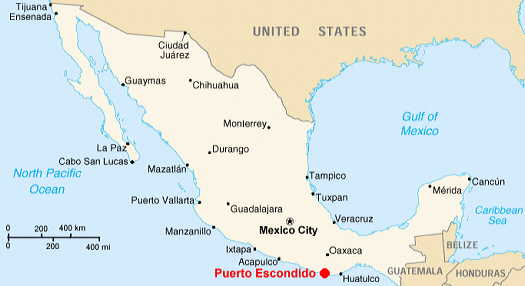
Oxaca to Puerto Escondido

Consequently, we decided to go to Puerto Escondido and then return to go
on our hike and then stay in Oaxaca for the Easter festivities.

The next morning we took an early bus to Puerto Escondido, Express
Service. The Express Service is a 16-seat van that goes directly over the
mountains. It is the shortest amount of time to get to P.E. However, we
had been warned by our friend not to take this route. Well, he was right.
The six-hour bus ride could have made us seasick with its continual side
to side motion interrupted by speed bumps every so often that would lift
you to the ceiling of the bus almost. The bus driver did give us a
20-minute break for a bathroom and lunch break in a village in the
mountains. You can guess that the bathroom and ´restaurant´facilities
were not the best. However, we did finally arrive in Puerto Escondido and
the search was on for a place to stay.


Road to Peurto Escondido from window of worse 6.5 hour bus ride ever


Road to Peurto Escondido from window of worse 6.5 hour bus ride ever


Arriving in Puerto Escondido we must have been shell-shocked by the bus experience and overwhelmed with again the difference in temperature, as it was very hot and humid, given the accommodation we decided to stay in. We can only tell you that the area and the grounds were lovely, as was the pool. However, we did not appreciate the student-housing look at the end of April and the small lizard climbing the wall and ceiling in our room in the middle of the night. We didn´t mind the Spanish music blaring from the bar on the other side of the room. We decided that night that we were going to be looking for another place the next morning.

We do have to say that one of the very nice things about this accommodation were the restaurants, and grocery store around the corner. We had a delicious Aztec Soup and stuffed green pepper Mexican style. It was a wonderful evening out. Then we went to the local grocery store where internet and two large screen t.v.´s were playing. When we began on the internet the outside cafe was fairly empty. As we worked on the internet a soccer game began between Mexico and Honduras.

As we inputted information on the computer we could hear the noise behind us grow louder and louder. When we turned around the patio was full of soccer fans wildly cheering their teams on. We had to leave it was much too noisy to continue. The grocery store assured us that after the game, the place would again be very, very, quiet.

The next morning we headed to Playa Zicatela which is the main Puerto Escondido beach. Playa Zicatela is the long stretch of beach located on the east side of Puerto Escondido.


Scene of beach in Playa Zicatela beach in Peurto Escondido

It is the main surfing area for Puerto Escondido, attracting surfers from all over the world, and is the site of annual surfing competitions in August and November.


Scene of Playa Zicatela beach in Peurto Escondido from balcony of room in Beuno Vista Hotel


The principal surfing season runs April through November when ground swells in the 6-15 foot (2-5 meter) range break into hollow tubes. For expert surfers only. Not for swimmers.


Warning flag of dangerous beach, no swimming, due to significant waves and undertow.


The November competition is associated with Puerto Escondido's Fiesta de Noviembre. The Mexpipe and World Masters Championships are held in August.


Scene of Playa Zicatela beach in Peurto Escondido from balcony of room in Beuno Vista Hotel


We were pleasantly surprised to encounter a beach with enticing cafes, restaurants and waves of the legendary Mexican Pipeline, which tests experienced surfers from far and wide. The waves are said to reach the height of 12 metres. The beach was truly beautiful. The waves were amazing to watch.

In the Playa Zicatela we found the Hotel Buena Vista. It is set on the main street above and is reached by a steep flight of steps up from Calle del Morro (street). From our breezy balcony high up on the top floor we could sit watch and listen to the waves during the afternoon sun and while falling asleep in the night.

From Mexico City to Oaxaca

After an enjoyable breakfast with our friends, we left to catch the 8:oo
a.m. bus for Oaxaca. Although the bus was second class, the seats were
comfortable, the space adequate and they played two movies, one of which
was the was The Nutty Professor with Robin Williams in Spanish. The
movies, reading and sleeping broke up the 6.5 ride.


Scene coming into Oaxaca City

We arrived in Oaxaca at approximately 2:30 p.m. Oaxaca is said to be one
of Mexico´s most beautiful and vibrant cities. A colonial city with a
lovely, tree-shaded central square, El Zocalo. Oaxaca is the heart of a
region whose highly creative populace produces the country´s finest range
of crafts and some of its most exciting contemporary art. Artists and
artisans alike are inspired by the state´s deep-rooted indigenous
traditions and by its bright southern light. Oaxaca has top-class
museums, lovely architecture, charming inns and hotels and its own
flavoursome version of Mexican cuisine.

We were looking forward to exploring Oaxaca after the Tour we had planned
in The Pueblos Mancomundos (Commonwealth of Villages). The P.M. are eight
remote Zapotec villages in the thickly forested highlands north of the
Valle De Tlacolula. For centuries, in a unique form of cooperation, the
villages have pooled the natural resources of their 290-sq-km territory,
which include extensive pine and oak forests, sharing the profits from
forestry and other enterprises. Today, seven of the villages also
cooperate in an excellent ecotourism program.

After finding a place to stay we headed off to the Expediciones Sierra
Norte office to book our Tour. After much discussion, i.e., hand
gesturing and map pointing we decided to book our trip on April 5th to
8th. In our conversation(s) we had mentioned our plan to go to
Puerto Escondido after our Tour. This would have meant that we would
have arrived in P.E. during the week before Easter, i.e., the Mexican
March Break. This would have made finding accommodations tricky not
to mention the volume of students and families enjoying the beach
there.

So we are going to Puerto Escondido before our tour.

Thursday, April 2, 2009

Back to Mexico City


Gerald with a new friend

It was bittersweet leaving San Miguel on Sunday, March 29th for Mexico City. By 6´.20a.m. we left for the bus station for our 7.00a.m., 3.5 hour bus journey in a first class bus. Yet again, we were given a sandwich and drink to enjoy on the bus in our spacious, air-conditioned bus, complete with the movie, Erin Brokovich.


Scene from window of Bus from Mexico City to Oaxaca


Thinking we had left a very clean, efficient bus station in San Miguel, we were astounded by the airport-like bus station in Mexico City. It is truly beautiful with its marble floors, ultra modern bathrooms. Upon leaving the bus station we went to a kiosk and bought a taxi cab ´ticket´for the zone, Centro Historico we were going to. Leaving the station we handed our ticket to a man organizing the cabs in a proficient
manner and we were directed to a cab. This method eliminated being swarmed by a number of cab drivers upon leaving a bus station and the fare was ´fair´, no negotiating before getting into the cab.


Govn't building


Mexico City is generally portrayed as an extremely crime-ridden city, so as first-time visitors we were surprised at how safe, and human it felt. In the evenings we went to a couple of favourite restaurants, which served delicious Mexican food.


Night scene in Centro Historico in Mexico City


Night scene in Centro Historico in Mexico City

One of the restaurants, Cafe de Tacuba was a fantasy of coloured tiles, brass lamps and oil paintings. This restaurant has been serving food since 1912. The evening we were here, we enjoyed the sound of a nine-person guitar band serenading us as they played and walked through the restaurant.


Night scene in Centro Historico in Mexico City


The hotel we stayed in the Centro Historico in Mexico city was the Hotel Gillow. Our friends had booked this hotel having stayed there before, enjoying the area and the reasonable rate. The Gillow boasts old-fashioned service and spacious carpeted rooms around a sunlit central courtyard. Our double room was spacious with a very large bathroom, two showers and overlooking one of the very interesting streets in the area.


Govn't building


While in Mexico City for two days we explored its uniqueness. Mexico City has much to offer. This is a city of serene parks and European-style plazas, busy street life and bustling markets, civilzed cantinas, gleaming office towers and centuries-old monasteries and churches. Over a hundred museums display pre'Hispanic, colonial and modern art or cover the city´s long history.


Centro Historico architecture in Mexico City


Mexico City is an endless banquet from soulful taco stalls to world-class restaurants. Music is everywhere on the streets from the ever-present organ grinders to indigenous dancers practicing in an open square.

Mexico City is over 2km high, and the City enjoys a springlike climate year-round. However, much to our surprise (or not), we enjoyed temperatures of around 80 degrees. One day the temperature reached a high of 88 degrees. However, this heat was not humid, but dry and not terribly uncomfortable as one might suspect.

The Centro Historico and Alameda Central is the historic heart of the city.

Mexico City Zocalo


It is the wide plaza known as the Zocalo, surrounded by the presidential palace, the metropolitan cathedral and the excavated site of the main temple of Aztec Tenochititlan.


Zocalo in Mexico City


Zocalo in Mexico City
The 34-block area surrounding the Zocalo is known as the Centro Historico and is crammed with notable old buildings and interesting museums.


zocalo cathedral

Walking in the Zocalo was breath-taking given the grandeur and architecture of the buildings it seemed never-ending. Walking to Alameda Central park, five blocks west of our hotel, we experienced many different festivals of markets, salsa bands and dancing and lovers, families enjoying a Sunday in the Park filled with fountains, statues and lovely landscaping.


market


Dominating the end end of the Alameda is the splendid white-marble palace called the Palacio De Bellas Artes.

Palacio de Belles Artes in Mexico City


Palacio de Belles Artes in Mexico City

It is a concert hall and arts centre commissioned by President Diaz. Construction began in 1905 under an Italian architect, Adamo Boari, who favoured neoclassical and art nouveau styles. Complications arose as the heavy marble shell sank into the spongy subsoil, and then the Mexican Revolution intervened. Architect Federico Mariscal eventually finished the interior in the 1930s, utilizing the more modern art deco style. It was an unbelievably beautiful building on the outside and inside.

Spending time in Mexico City we walked on the Paseo de la Reforma, the grandest boulevard that runs through the city´s heart, connecting the Alameda to the Bosque de Chapultepec.


The Monumento a la Independenica (Angel of Independance) on the Paseo de la Reforma Boulevard

Along the way, the Monumento a la Independencia (aka El Angel) marks the northern side of the Zona Rosa, a glitzy shopping, hotel and nightlife, restaurant district.


Outdoor Art Exhibit in Centro Historico (Old church in background), Mexico City

Along this boulevard we encountered statures, and sculptures of seating by
various artists. Yet another indicator of Mexicans love of art.

The Zona Rosa (Pink Zone) was developed as an international playground and shopping district during the 1950´s when it enjoyed a cosmopolitan panache.

Zona Rosa District, Antique District

People-watching from its sidewalk cafes reveals a high degree of diversity than elsewhere.

Zona Rosa District, Street Scene
We enjoyed lunching here, people-watching and listening to the various bands playing. In this area there was an exquisite antique area. We saw some of the most beautiful things there.

Outdoor Art Exhibit in Centro Historico, Mexico City


While in Mexico City we went to the Museo De Arte Popular, recently opened
in 2006. This is a major showcase for Mexico´s folk arts and traditions.

Museo de Arte Popular Exhibit (Costumes of Indigenous Populations in Mexico City

Contemporary crafts from all over Mexico are thematically displayed on the museum´s three levels, including pottery from Michacan, carnival masks from Chiapas and Alebrijes (animal figures) from Oaxaca and trees of life from Puebla. The museum itself is an outstanding example of 1920´s art deco by architect Vicente Mendiola.


Frida Kahlo home


Frida Kahlo home


Enjoying Mexico City so very much, it was difficult to think about having to leave. However, knowing that we would be coming back and have some time to explore it more was reassuring to us. On Tuesday, March 31st, our friends left Mexico City to return home, as we set out to go to Oaxaca City.

Leaving Mexico City on a first-class bus, we set out on a six and half-hour ride to connect with the Sierra Norte Tour to begin a hiking experience from village to village in the mountains.

To be continued.... going for a walk on the beach to see the sunset yet again.

San Miguel

We went to the Hot Springs on Thursday, March 26th. for the afternoon.
The area had been somewhat beautified since our friends had been there
last year. Cement sidewalks and the men´s bathroom had been redone. The
bathroom was very nice, indeed.

The surrounds of San Migul are blessed with hot mineral springs. Their
original spiritual significance could be felt in the La Bruta spring we
attended. The day we attended La Gruta it was not very busy at all, but
very quiet, which added tothe tranquil experience. The La Gruta has three
small pools where a thermal spring is channeled. The hottest is in a cave
entered through a 27m tunnel, with water gushing from the roof, lit bya
single shaft of sunlight. It was truly amazing to stand under the
waterfall and have a back massage standing in the hot spring housed in a
cave.

That evening we attended a Birthday Party at ´Mama Mia´, which served
mexican food with two wonderful guitarist playing while eight of us
enjoyed our meals.


The day after our La Gruta trip, we wpnt the day exploring San Miguel. We
had a group BBQ with our friends and the others who stay at Villa Martha,
a wonderful group of very friendly people.

After the BBQ we decided to go to an evening concert by the band Voodoo
Chilli. Our friends knew the lead guitarist and his family very well. The
band played a tribute to Muddy Waters and Ray Charles. It was a wonderful
concert held in a small, intimate venue with amazing acoustics.

Wednesday, April 1, 2009

More Fun in San Miguel

We are currently in Puerto Escondido, some six hours away from Oaxaca. It is a long story. While we are cool, the lighting is not the best and the keyboard is
somewhat different.


View from Robert´s home. He was one of the Hash House Harriers that we
hiked with on Monday, March 23rd. The Hash House Harriers were started by
a group of GI´s in Britain (we think) to keep in shape after returning
home from the War. One of the ´oldest´ member of this group was a woman,
who began hiking with the Hash House Harriers in Eygpt.


Robert´s back garden.


Robert´s garden. The picture cannot begin to capture the reality of the
garden. It was truly unique.


Robert´s Garden


sunset in San Miguel from rooftop of the place we were staying at.

Another sunset in san Miguel from rooftop. The lighting in San
Miguel is unique and it is the reason it is an artists´ town filled
with many painters and artists.


Jardin at night.


Jardin at night.

Sunday, March 29, 2009

San Miguel

We are staying on this street.


On Saturday, March 21 we explored San |Miguel , visiting the Artesian
Market and participating in the festivities of the Jardin (town square).
At this time there was a Cuban Festival complete with Cuban music and
dancing. We participated with everyone in Salsa Dancing outdoors.

On Sunday, March 22nd, Gerald and I joined the hiking group in San
Miguel with some other people we had met previously. This is a picture of the canyon.

The three-hour hike
in Boca de Canada was along a river bed in the country, just twenty
minutes outside of San Miguel.

It was wonderful to see the different
vegetation, I.e., various cacti, thorn bushes, no insects, but
very hot mid morning. “Cowboys” on horses watching the sheep, goats on
the hills and river bed.

That evening, mush to everyone’s surprise, it rained. We went to the most
beautiful Starbucks, I have ever been in.


The tables and chairs were
arranged under a roof, while the centre of the hug outdoors contained
beautiful, large plants, stonework and wrought iron. San Miguel’s
architecture is beautiful with wrong iron in front of windows, doors and
beautiful wood doors framed with cement/stone .

Beautiful flower pots
decorate the stone gardens. The amazing Jacarando tree, with its
stunning purple flowers, currently in bloom, decorates San Miguel’s
landscape.

On Monday March 23rd, we decided to participate in the Historical
Walking Tour of San Miguel. We met the tour guides in the Jardin, early
that morning.

In the Jardin, we saw the little children dressed for the
first day of Spring Parade dressed in costumes of bubble bees,
butterflies, watering cans, flowers , etc.
Some of the sights we visited included the Parrouguia de San Miguel
Arcangel. This parish church’s pink ‘wedding cake towers dominate the
Jardin. The strange pinnacles were designed by indigenous stone mason in
the late 19th century.

The stone mason based the design from a postcard of a Belgium Church and
instructed builders by scratching plans in the sand with a stick. The
rest of the church dates from the late 17th century. Continuing around
the downtown of San Miguel there are many churches we visited and took
beautiful pictures.

The Oratorio de San Felipe Neri is a 18th century church with a pale-pink main
façade in the baroque with an indigenous influence. Inside the church are
33 oil paintings showing scenes from the life of San Felipe Neri, the 16th
century Florentine who founded the Oratorio Catholic order. The tour
included many churches and then we visited the Escuela De Bellas Artes,
the School of Fine Arts, which is housed in the beautiful former monastery
of La Conception church, which was converted into a fine-arts school in
1938.

The day continues with an interesting walk put on by the Hash House
Harriers. This international group has a motto we’re ‘a drinking club
with a running problem’ We follow a laid out course through town following a
trail of flour and chalk arrows. This grueling course took about 2 and a
half hours to complete and finished at one of the members, home. At the
host, Robert’s, home we enjoyed singing risqué songs, and drinking beer
while overlooking San Miguel. The picture is the view from a 'Hash House Harriers' balcony after a HHH hike.
Robert’s home was unbelievable -- see
pictures.

On the 24th, we went to Tuesday Market.
Here, we bought some clothes for
the house-warming party that afternoon, food, I.e., avocados,
strawberries, chicken (to cook). It was a very interesting, fun place to
visit -- see pictures.

In the afternoon we attended a house-warming for a couple who had bought a
condo about 10 minutes from the Jardin in another interesting part of San
Miguel.

Their home was beautiful as were the grounds, with an exercise
facility (see pictures) a Jacuzzi, and a large, very warm swimming pool
with a swim-up bar.

On Wednesday, a friend of our friends, a woman from Walkerton, invited us
to go to Pozos for the day in her 1989 Ford Grande Marquis -- a spacious
limousine which rides comfortably on the cobblestone streets.


Less than
100 years ago, Mineral de Pozos was a flourishing silver-mining centre of
around 70,000 people, but with the 1910 revolution and the flooding of the
mines, the populations dwindled to less than 2,500.


Empty houses, a large and unfinished church and discarded mine workings and shafts were the legacy of abandonment. Today, this tiny place is trying valiantly to win
a place on the map. We explored the crumbling buildings, fascinating
surroundings, including several mine ruins. The picture of the gas pump is in San Miguel and it is a fixture in the area that has been there for quite some time. When we saw it, it had been returned after being taken away to be fixed.