Thursday, April 2, 2009

Back to Mexico City


Gerald with a new friend

It was bittersweet leaving San Miguel on Sunday, March 29th for Mexico City. By 6´.20a.m. we left for the bus station for our 7.00a.m., 3.5 hour bus journey in a first class bus. Yet again, we were given a sandwich and drink to enjoy on the bus in our spacious, air-conditioned bus, complete with the movie, Erin Brokovich.


Scene from window of Bus from Mexico City to Oaxaca


Thinking we had left a very clean, efficient bus station in San Miguel, we were astounded by the airport-like bus station in Mexico City. It is truly beautiful with its marble floors, ultra modern bathrooms. Upon leaving the bus station we went to a kiosk and bought a taxi cab ´ticket´for the zone, Centro Historico we were going to. Leaving the station we handed our ticket to a man organizing the cabs in a proficient
manner and we were directed to a cab. This method eliminated being swarmed by a number of cab drivers upon leaving a bus station and the fare was ´fair´, no negotiating before getting into the cab.


Govn't building


Mexico City is generally portrayed as an extremely crime-ridden city, so as first-time visitors we were surprised at how safe, and human it felt. In the evenings we went to a couple of favourite restaurants, which served delicious Mexican food.


Night scene in Centro Historico in Mexico City


Night scene in Centro Historico in Mexico City

One of the restaurants, Cafe de Tacuba was a fantasy of coloured tiles, brass lamps and oil paintings. This restaurant has been serving food since 1912. The evening we were here, we enjoyed the sound of a nine-person guitar band serenading us as they played and walked through the restaurant.


Night scene in Centro Historico in Mexico City


The hotel we stayed in the Centro Historico in Mexico city was the Hotel Gillow. Our friends had booked this hotel having stayed there before, enjoying the area and the reasonable rate. The Gillow boasts old-fashioned service and spacious carpeted rooms around a sunlit central courtyard. Our double room was spacious with a very large bathroom, two showers and overlooking one of the very interesting streets in the area.


Govn't building


While in Mexico City for two days we explored its uniqueness. Mexico City has much to offer. This is a city of serene parks and European-style plazas, busy street life and bustling markets, civilzed cantinas, gleaming office towers and centuries-old monasteries and churches. Over a hundred museums display pre'Hispanic, colonial and modern art or cover the city´s long history.


Centro Historico architecture in Mexico City


Mexico City is an endless banquet from soulful taco stalls to world-class restaurants. Music is everywhere on the streets from the ever-present organ grinders to indigenous dancers practicing in an open square.

Mexico City is over 2km high, and the City enjoys a springlike climate year-round. However, much to our surprise (or not), we enjoyed temperatures of around 80 degrees. One day the temperature reached a high of 88 degrees. However, this heat was not humid, but dry and not terribly uncomfortable as one might suspect.

The Centro Historico and Alameda Central is the historic heart of the city.

Mexico City Zocalo


It is the wide plaza known as the Zocalo, surrounded by the presidential palace, the metropolitan cathedral and the excavated site of the main temple of Aztec Tenochititlan.


Zocalo in Mexico City


Zocalo in Mexico City
The 34-block area surrounding the Zocalo is known as the Centro Historico and is crammed with notable old buildings and interesting museums.


zocalo cathedral

Walking in the Zocalo was breath-taking given the grandeur and architecture of the buildings it seemed never-ending. Walking to Alameda Central park, five blocks west of our hotel, we experienced many different festivals of markets, salsa bands and dancing and lovers, families enjoying a Sunday in the Park filled with fountains, statues and lovely landscaping.


market


Dominating the end end of the Alameda is the splendid white-marble palace called the Palacio De Bellas Artes.

Palacio de Belles Artes in Mexico City


Palacio de Belles Artes in Mexico City

It is a concert hall and arts centre commissioned by President Diaz. Construction began in 1905 under an Italian architect, Adamo Boari, who favoured neoclassical and art nouveau styles. Complications arose as the heavy marble shell sank into the spongy subsoil, and then the Mexican Revolution intervened. Architect Federico Mariscal eventually finished the interior in the 1930s, utilizing the more modern art deco style. It was an unbelievably beautiful building on the outside and inside.

Spending time in Mexico City we walked on the Paseo de la Reforma, the grandest boulevard that runs through the city´s heart, connecting the Alameda to the Bosque de Chapultepec.


The Monumento a la Independenica (Angel of Independance) on the Paseo de la Reforma Boulevard

Along the way, the Monumento a la Independencia (aka El Angel) marks the northern side of the Zona Rosa, a glitzy shopping, hotel and nightlife, restaurant district.


Outdoor Art Exhibit in Centro Historico (Old church in background), Mexico City

Along this boulevard we encountered statures, and sculptures of seating by
various artists. Yet another indicator of Mexicans love of art.

The Zona Rosa (Pink Zone) was developed as an international playground and shopping district during the 1950´s when it enjoyed a cosmopolitan panache.

Zona Rosa District, Antique District

People-watching from its sidewalk cafes reveals a high degree of diversity than elsewhere.

Zona Rosa District, Street Scene
We enjoyed lunching here, people-watching and listening to the various bands playing. In this area there was an exquisite antique area. We saw some of the most beautiful things there.

Outdoor Art Exhibit in Centro Historico, Mexico City


While in Mexico City we went to the Museo De Arte Popular, recently opened
in 2006. This is a major showcase for Mexico´s folk arts and traditions.

Museo de Arte Popular Exhibit (Costumes of Indigenous Populations in Mexico City

Contemporary crafts from all over Mexico are thematically displayed on the museum´s three levels, including pottery from Michacan, carnival masks from Chiapas and Alebrijes (animal figures) from Oaxaca and trees of life from Puebla. The museum itself is an outstanding example of 1920´s art deco by architect Vicente Mendiola.


Frida Kahlo home


Frida Kahlo home


Enjoying Mexico City so very much, it was difficult to think about having to leave. However, knowing that we would be coming back and have some time to explore it more was reassuring to us. On Tuesday, March 31st, our friends left Mexico City to return home, as we set out to go to Oaxaca City.

Leaving Mexico City on a first-class bus, we set out on a six and half-hour ride to connect with the Sierra Norte Tour to begin a hiking experience from village to village in the mountains.

To be continued.... going for a walk on the beach to see the sunset yet again.

San Miguel

We went to the Hot Springs on Thursday, March 26th. for the afternoon.
The area had been somewhat beautified since our friends had been there
last year. Cement sidewalks and the men´s bathroom had been redone. The
bathroom was very nice, indeed.

The surrounds of San Migul are blessed with hot mineral springs. Their
original spiritual significance could be felt in the La Bruta spring we
attended. The day we attended La Gruta it was not very busy at all, but
very quiet, which added tothe tranquil experience. The La Gruta has three
small pools where a thermal spring is channeled. The hottest is in a cave
entered through a 27m tunnel, with water gushing from the roof, lit bya
single shaft of sunlight. It was truly amazing to stand under the
waterfall and have a back massage standing in the hot spring housed in a
cave.

That evening we attended a Birthday Party at ´Mama Mia´, which served
mexican food with two wonderful guitarist playing while eight of us
enjoyed our meals.


The day after our La Gruta trip, we wpnt the day exploring San Miguel. We
had a group BBQ with our friends and the others who stay at Villa Martha,
a wonderful group of very friendly people.

After the BBQ we decided to go to an evening concert by the band Voodoo
Chilli. Our friends knew the lead guitarist and his family very well. The
band played a tribute to Muddy Waters and Ray Charles. It was a wonderful
concert held in a small, intimate venue with amazing acoustics.

Wednesday, April 1, 2009

More Fun in San Miguel

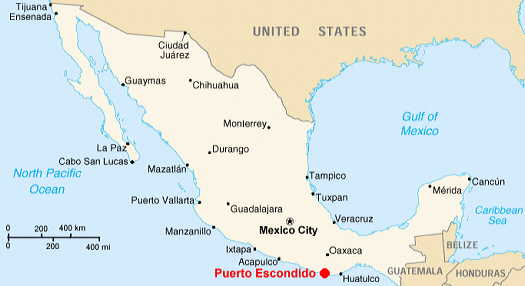
We are currently in Puerto Escondido, some six hours away from Oaxaca. It is a long story. While we are cool, the lighting is not the best and the keyboard is
somewhat different.


View from Robert´s home. He was one of the Hash House Harriers that we
hiked with on Monday, March 23rd. The Hash House Harriers were started by
a group of GI´s in Britain (we think) to keep in shape after returning
home from the War. One of the ´oldest´ member of this group was a woman,
who began hiking with the Hash House Harriers in Eygpt.


Robert´s back garden.


Robert´s garden. The picture cannot begin to capture the reality of the
garden. It was truly unique.


Robert´s Garden


sunset in San Miguel from rooftop of the place we were staying at.

Another sunset in san Miguel from rooftop. The lighting in San
Miguel is unique and it is the reason it is an artists´ town filled
with many painters and artists.


Jardin at night.


Jardin at night.

Sunday, March 29, 2009

San Miguel

We are staying on this street.


On Saturday, March 21 we explored San |Miguel , visiting the Artesian
Market and participating in the festivities of the Jardin (town square).
At this time there was a Cuban Festival complete with Cuban music and
dancing. We participated with everyone in Salsa Dancing outdoors.

On Sunday, March 22nd, Gerald and I joined the hiking group in San
Miguel with some other people we had met previously. This is a picture of the canyon.

The three-hour hike
in Boca de Canada was along a river bed in the country, just twenty
minutes outside of San Miguel.

It was wonderful to see the different
vegetation, I.e., various cacti, thorn bushes, no insects, but
very hot mid morning. “Cowboys” on horses watching the sheep, goats on
the hills and river bed.

That evening, mush to everyone’s surprise, it rained. We went to the most
beautiful Starbucks, I have ever been in.


The tables and chairs were
arranged under a roof, while the centre of the hug outdoors contained
beautiful, large plants, stonework and wrought iron. San Miguel’s
architecture is beautiful with wrong iron in front of windows, doors and
beautiful wood doors framed with cement/stone .

Beautiful flower pots
decorate the stone gardens. The amazing Jacarando tree, with its
stunning purple flowers, currently in bloom, decorates San Miguel’s
landscape.

On Monday March 23rd, we decided to participate in the Historical
Walking Tour of San Miguel. We met the tour guides in the Jardin, early
that morning.

In the Jardin, we saw the little children dressed for the
first day of Spring Parade dressed in costumes of bubble bees,
butterflies, watering cans, flowers , etc.
Some of the sights we visited included the Parrouguia de San Miguel
Arcangel. This parish church’s pink ‘wedding cake towers dominate the
Jardin. The strange pinnacles were designed by indigenous stone mason in
the late 19th century.

The stone mason based the design from a postcard of a Belgium Church and
instructed builders by scratching plans in the sand with a stick. The
rest of the church dates from the late 17th century. Continuing around
the downtown of San Miguel there are many churches we visited and took
beautiful pictures.

The Oratorio de San Felipe Neri is a 18th century church with a pale-pink main
façade in the baroque with an indigenous influence. Inside the church are
33 oil paintings showing scenes from the life of San Felipe Neri, the 16th
century Florentine who founded the Oratorio Catholic order. The tour
included many churches and then we visited the Escuela De Bellas Artes,
the School of Fine Arts, which is housed in the beautiful former monastery
of La Conception church, which was converted into a fine-arts school in
1938.

The day continues with an interesting walk put on by the Hash House
Harriers. This international group has a motto we’re ‘a drinking club
with a running problem’ We follow a laid out course through town following a
trail of flour and chalk arrows. This grueling course took about 2 and a
half hours to complete and finished at one of the members, home. At the
host, Robert’s, home we enjoyed singing risqué songs, and drinking beer
while overlooking San Miguel. The picture is the view from a 'Hash House Harriers' balcony after a HHH hike.
Robert’s home was unbelievable -- see
pictures.

On the 24th, we went to Tuesday Market.
Here, we bought some clothes for
the house-warming party that afternoon, food, I.e., avocados,
strawberries, chicken (to cook). It was a very interesting, fun place to
visit -- see pictures.

In the afternoon we attended a house-warming for a couple who had bought a
condo about 10 minutes from the Jardin in another interesting part of San
Miguel.

Their home was beautiful as were the grounds, with an exercise
facility (see pictures) a Jacuzzi, and a large, very warm swimming pool
with a swim-up bar.

On Wednesday, a friend of our friends, a woman from Walkerton, invited us
to go to Pozos for the day in her 1989 Ford Grande Marquis -- a spacious
limousine which rides comfortably on the cobblestone streets.


Less than
100 years ago, Mineral de Pozos was a flourishing silver-mining centre of
around 70,000 people, but with the 1910 revolution and the flooding of the
mines, the populations dwindled to less than 2,500.


Empty houses, a large and unfinished church and discarded mine workings and shafts were the legacy of abandonment. Today, this tiny place is trying valiantly to win
a place on the map. We explored the crumbling buildings, fascinating
surroundings, including several mine ruins. The picture of the gas pump is in San Miguel and it is a fixture in the area that has been there for quite some time. When we saw it, it had been returned after being taken away to be fixed.

Friday, March 27, 2009

Arriving: Mexico City to Queretaro to San Miguel

We left R. R. 2 Baden on Wednesday morning at 3:30 a.m., arriving in Mexico City , via Atlanta city, at 7:30 a.m. The weather was a pleasant 70 degrees. After a 1.5 hour wait to get through Customs, we followed directions from our friends regarding the bus transportation to Queretaro where our friends were meeting us.

The bus was luxurious, complete with a ham and cheese sandwich, drink and spacious seats. The ride to Queretaro was 3.5 hours long.


Meeting out friends in Queretaro, we noticed the cleanliness of the Station and the streets outside. We were surprised not to be ‘swarmed’ by taxi cab drivers as we have been in the past. Queretaro is a large city, close to one million people. Queretaro became a center of intrigue among disaffected people plotting to free Mexico from Spanish rule. In 1917 the Mexican Constitution was drawn up.

Meeting our friends and taking to bus in San Miguel, we arrived around 8:00 p.m. that evening.

'

San Miguel is a stunning, clean, neat city with colonial architecture, enchanting hilly cobblestone streets, with narrow (single) sidewalks and amazing light that attracts arts from around the world.


Regular festivals, fireworks and parades dominate the local scene. Our first couple of nights were spent being woken up by fireworks and church bells ringing at all hours of the night for all the Saints in the area. Numerous galleries are stocked with some of the best Mexican artesian and cultural activities are continuing being held for residents and visitors.

There are few sights, as a Mexican-declared national monument, San |Miguel is the Sight. San Miguel's weather is considered among the top destinations for people wanting warm, but not hot days and cool, not cold evenings to sleep comfortably, every day. San Miguel is in the central highlands of Mexico with an elevation of 6,500 feet.


The next morning, MaryIris attended a Yoga Class with her friend, followed by an interesting lunch of scrambled eggs and refried beans mixed together in burrito style with fried plantain in a beautiful surrounding. Gerald took a three-hour tour of the downtown of San Miguel with his friend followed by lunch outdoors where a beer and burger cost less than $5.00 Canadian. Gerald noticed that the bike riders do not require helmets unlike back home.

Very quickly it becomes obvious to us that there is something for everyone in San Miguel. In the weekly “Atencion” the Quepasa section has a calendar of weekly events it has four pages of listings, everything from Salsa Dancing to Art Openings, to Concerts, to Workshops, Yoga, Festivals, Slide Shows, Movies Walking Tours, Cooking Classes, Social Lunches, etc., etc.

People in the Villa \Martha, where we are staying, come from |London, Ontario, Columbia, Burlington, Long Island, \N.Y., Ottawa, Waterloo and San Miguel. Many of them stay for three months to enjoy the weather and the activities and the warm, loving nature of the Mexican people and their hospitality

In the evening of our first day in San Miguel, we enjoy good company, good wine for very cheap and a walk down to the Jardin, town square.

The second day in San Miguel, MaryIris and friend attended a Women’s Lunch and Card Making Workshop. It was a warm, wonderful afternoon of laughter and community-building. Gerald explored San Miguel and had another interesting lunch with travellers in the area. That evening we went to the El Charco Del \Ingenio Jardin Botanico for an Opera.

The El Charco del Ingenio Botanical Garden reserve covers more than 300 acres adjacent to San M|iguel.


It is a nongovernmental initiative, begun in 1990, to rescue and protect a treasured area benefiting and open to all sectors of the community. It has an extensive collection of cacti and other species of Mexican planstys, many of which are rare or in danger of extinction. In 1995, the Garden was awarded the "National prize of Ecological merit by the Mexican government. It was declared a peace zone by the Dalai Lama in 2004.


Before the Opera we watched a traditional indigenous dance which was spectacular.


Following this ceremony, we participated in an Equinox ceremony in Spanish and English. We were all given a prayer of intention and seeds to sow.

The \Opera, Equinoccio De Primavera was held in the gorge of the Botanical Garden with Soprano Libico Belinda Gonzalez and Tenor Rodrigo Garciarroyo accompanied by pianist Mario Alberto Hernandez. The natural acoustics of the canyon gorge were breath-taking as was the sight of many people sitting on various rocks at various levels in various attire enjoying the music.


The Internet describes this show as:
"Spring Equinox CONCERT –
OPERA IN THE CANYON – 5:30p.m.

As is customary every year, El Charco celebrates this festival of the Sun with a musical offering. This year a special performance by Rodrigo Garciarroyo (tenor), Belinda Gonzalez (soprano) and Mario Alberto Hernandez (pianist) will take place in the canyon’s natural amphitheatre – sculpted by millennia of flowing water. The program will have arias from various operas by Puccini and others as well as some Spanish songs from Zarzuelas."

Thursday, March 26, 2009

San Miguel de Allende

"Gerald and I are having mucho fun, i.e., parties, i.e., housewarmings, birthdays, get-togethers, sight-seeing, hiking, etc.
We also went to an opera in a canyon -- spectacular. It's a 4-hour trip to San Miguel from Mexico City's Terminal Norte, San Miguel is a beautiful city with much to do.
We are five minutes away from the Jardin (the town square). Lots of shops, etc. also. We are off to Mexico City on Sunday."


"Jardin" is #1 on the map.

San Miguel de Allende, nestled in mountainous central region of Mexico, is part of the "Bajio" region of the state of Guanajuato. This "low" region in reality averages about 7000 feet, but is so called for being a relatively flat area ringed by mountains.

San Miguel El Grande (as it was originally known) was founded by a Franciscan monk in 1542. It was an important stop over of the silver route from Zacatecas.

When the Mexican War of Independence began in the nearby town of Dolores (now know as Dolores Hidalgo) on San Miguel de Allende Home Town Hero Ignacio Allende September 16th, 1810, in an act now celebrated as "El Grito", the rapidly growing revolutionary army came to San Miguel El Grande. Dolores Hidalgo is known as the "Cradle of National Independence" while San Miguel calls itself the "Forge of National Independence", for it was here that General Ignacio Allende joined the army as Padre Miguel Hidalgo's chief lieutenant and led the army to several victories. Allende was not able to enjoy a Mexico independent from Spanish oppression, however, as he was captured during battle and summarily executed.San Miguel de Allende's Plaza de Allende Today He is now a national hero, and the town renamed itself "San Miguel de Allende" in 1826 to honor his actions.

Cantinflas, Mexican comic actor who starred in many Hollywood films including Around the World In 80 DaysAs the mineral wealth waned, San Miguel was popular as both a quiet, beautiful place to live and an attraction for the wealthy for its natural hot springs. The world famous Mexican comic actor, Cantinflas frequented San Miguel in the 1950's and 1960's, bringing with him an entourage of filmstars, singers and hangers-on.

By 1900, the town itself was in danger of dying out. Having been declared a national monument in 1926 (no neon signs, no modern buildings), the old centro district still has the colonial style elegance of its wealthy past.

It was after World War II that San Miguel de Allende began to revive as a tourist attraction, as many GI's discovered that their education grants stretched further in Mexico at the US accredited art school, the Instituto Allende, founded in 1950.

San Miguel de Allende is world famous for its mild climate, colonial architecture, and large expatriate population, which estimates number in the 6,000 - 8,000 range - in a total population of about 85,000. Of these, the majority are Americans, with a healthy percentage of Canadians, and smattering of europeans and other nationalities. Many people have elected to retire here, as the large community of foreigners has brought about a number of conveniences that would normally not be available in a town of this size:

* The Biblioteca Publica, is a non-profit institution which has made available many thousands of books in both English and Spanish to the community. It is also the second-largest collection of English language books in Mexico.
* There is an active theatre community, and rarely a weekend passes without some play or another running in one of the 3 theaters.
* Additionally El Teatro Angela Peralta often is host to traveling productions as varied as Flamenco Guitarists to Chinese Acrobats.
* Many more quality restaurants, bars, and other services that normally cannot be found in a town of this size.
* It has a 2 screen movie theater that shows relatively recent US films with Spanish subtitles.
* It has a very active volunteer community, with over 30 active charitable organizations, chapters and groups.

Tuesday, March 24, 2009

In San Miguel

"We are having too much fun. Gerald and I are very busy hiking, sight seeing, etc. Today we are going to the market and to a house warming party!"